Blog

August 18, 2026
Filip M. Rams
Posted in Business Services
Part I of this series addressed what a qualified small business stock exit is worth after the 2025 amendments and why the answer now depends on a date. This installment addresses the threshold question that precedes any valuation exercise: whether the issuing company qualifies at all.
When a client asks whether their shares are QSBS, the question has two halves that fail in different ways. The company must satisfy tests about what it is and what it does. Separately, the particular block of stock must satisfy tests about how it was acquired and what has happened since. This Part II addresses the company; Part III addresses the stock.
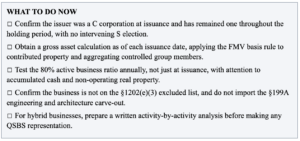
QSBS must be stock in a C corporation. The requirement that trips practitioners is not the initial one but the durational one: under IRC §1202(c)(2)(A), the issuer must be a C corporation during substantially all of the taxpayer’s holding period, not merely on the date of issuance. A subsequent S election is therefore fatal to QSBS status for stock that would otherwise have qualified, and it is a decision often made years later by a different advisor for unrelated reasons.
Certain corporations are ineligible regardless of their activities. IRC §1202(e)(4) excludes DISCs and former DISCs, regulated investment companies, real estate investment trusts, real estate mortgage investment conduits, and cooperatives. These rarely arise in venture-backed companies but are worth confirming in diligence on operating businesses and holding structures.
The issuer must be a domestic corporation. For a state-law corporation, this is trivial. For an LLC that has elected to be taxed as a C corporation, it is a source of persistent and unnecessary confusion — addressed at length in Part IV. The short answer is that such an entity is a domestic corporation and can issue valid QSBS.
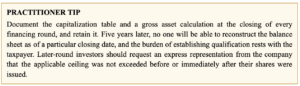
The issuer must be a “qualified small business” at the time of each stock issuance, meaning its aggregate gross assets must not have exceeded the applicable ceiling at any time before the issuance or immediately after taking the issuance proceeds into account. IRC §1202(d)(1). The ceiling is $50 million for stock issued on or before July 4, 2025, and $75 million for stock issued thereafter. Several mechanics matter in practice.
Throughout substantially all of the taxpayer’s holding period, at least 80% of the corporation’s assets by value must be used in the active conduct of one or more qualified trades or businesses. IRC §1202(e)(1). This is a continuous requirement, not a one-time test at issuance, and it is the requirement most likely to fail quietly as a company matures. Three statutory refinements bear on the test in practice.
The failure modes are predictable. A profitable company accumulates cash well beyond any defensible working capital need. A software company begins offering implementation services that look increasingly like consulting. A company buys its own building and holds surplus land. Any of these can push the asset mix past the threshold without anyone noticing until diligence.
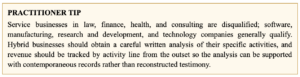
IRC §1202(e)(3) enumerates activities that do not constitute a qualified trade or business: services in the fields of health, law, engineering, architecture, accounting, actuarial science, performing arts, consulting, athletics, financial services, and brokerage services; any trade or business whose principal asset is the reputation or skill of one or more employees; banking, insurance, financing, leasing, investing, and similar businesses; farming; any business involving the production or extraction of products subject to depletion under IRC §§613 or 613A; and the operation of a hotel, motel, restaurant, or similar business. Software, technology, and manufacturing companies are generally eligible.
One trap deserves specific mention. Section 1202’s list is not coextensive with the “specified service trade or business” definition in IRC §199A. Engineering and architecture are excluded under §1202 but are expressly carved out of the §199A SSTB definition. Advisors who are fluent in the §199A analysis routinely and incorrectly import that carve-out into §1202, with the result that engineering firms are told their stock qualifies when it does not.
Practitioners should understand how little authority there is here. Treasury has never issued regulations under §1202 beyond a single set addressing the effect of redemptions on QSBS status, so the excluded-business analysis is largely an exercise in reading statutory text. The Service has issued a small number of private letter rulings that illuminate the boundaries: PLR 201436001 concluded that a pharmaceutical company commercializing experimental drugs was engaged in a qualified trade or business rather than the “health” business, and PLR 202114002 concluded that an insurance agency was not performing “brokerage services.”
Both rulings are useful for their reasoning, and each is “authority” for purposes of the substantial-authority standard under Treas. Reg. §1.6662-4(d)(3)(iii). Neither may be used or cited as precedent. IRC §6110(k)(3). For a hybrid business — one that combines a clearly qualifying product with a services component, or that sits near a line the statute draws imprecisely — the right approach is a documented, activity-by-activity analysis prepared before any QSBS representation is made, not after a buyer’s counsel raises the question.
Coming next in this series: Part III — Does the Stock Qualify, and Will It Still? Original issuance, eligible holders, the per-issuer cap, the redemption rules, and transfers at gift and death.
For further information on this topic, please reach out to Filip M. Rams at frams@smgglaw.com
Disclaimer
This article is provided for general informational and educational purposes only. It does not constitute legal or tax advice and does not create an attorney-client relationship. The law in this area is complex and fact-specific. Readers should consult qualified legal and tax counsel before taking any action based on the information contained herein. Prior results in similar matters do not guarantee a similar outcome.


©2026 Strassburger McKenna Gutnick & Gefsky | All Rights Reserved | Attorney Advertising | Disclaimer | Sitemap
