Blog

August 11, 2026
Filip M. Rams
Posted in Business Services
A founder who incorporated in 2023 and closed a priced round in March 2026 now owns two different tax assets in the same company. The shares issued at formation are governed by one set of rules; the shares issued in the round by another, with a different dollar cap, a different gross-asset ceiling, and a holding period that pays out in three stages rather than one. Neither block is uniformly better. Both must be tracked separately for the life of the investment. That is the practical consequence of the most significant amendment to Section 1202 in fifteen years.
This four-part series walks practitioners through the QSBS rules as they stand after the 2025 amendments. Part I addresses what the benefit is worth; Part II, whether the issuing company qualifies; Part III, whether a particular block of stock qualifies and will still qualify at exit; Part IV, the structural fixes available when the answer is no.
IRC §1202 permits eligible non-corporate taxpayers to exclude from gross income some or all of the gain realized on the sale or exchange of qualified small business stock (QSBS). Because excluded gain never enters gross income, it escapes both the capital gains tax and the 3.8% net investment income tax under IRC §1411. The exclusion is capped per issuer at the greater of a dollar figure or ten times the taxpayer’s aggregate adjusted basis in stock of that issuer disposed of during the year, reduced by gain previously excluded as to the same issuer and halved for married taxpayers filing separately. IRC §1202(b)(1), (b)(3).
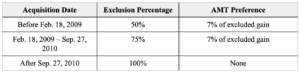
Section 1202 was enacted in 1993 as part of the Omnibus Budget Reconciliation Act of 1993, Pub. L. No. 103-66. In its original form it excluded only half the gain, treated 7% of the excluded amount as an alternative minimum tax preference under IRC §57(a)(7), and taxed the remainder at 28%. The net benefit was modest, and the provision went largely unused for fifteen years.
The exclusion rose to 75% for stock acquired between February 18, 2009 and September 27, 2010. The Small Business Jobs Act of 2010, Pub. L. No. 111-240, introduced the 100% exclusion for stock acquired after September 27, 2010; the Tax Relief Act of 2010 extended it; and the PATH Act of 2015, Pub. L. No. 114-113, made it permanent.
The One Big Beautiful Bill Act (OBBBA), Pub. L. No. 119-21 (July 4, 2025), made three principal changes to §1202: a tiered gain exclusion tied to shorter holding periods, an increase in the per-issuer dollar cap from $10 million to $15 million, and an increase in the aggregate gross-asset ceiling from $50 million to $75 million. Both figures are indexed for inflation, with the per-issuer cap adjusted for taxable years beginning after 2026 and the gross-asset ceiling adjusted for stock issued in calendar years after 2026.
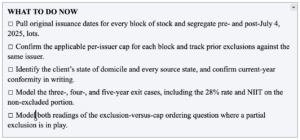
Critically, the amendments apply only to QSBS issued after July 4, 2025. Stock issued on or before that date continues to be governed by the prior-law rules. Practitioners must therefore analyze QSBS under a two-regime framework keyed to the date of original issuance — not the date a particular holder acquired the shares, a distinction that matters for transferees who tack a donor’s or decedent’s holding period under §1202(h).
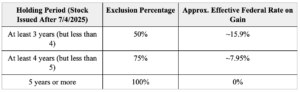
The portion of gain that is not excluded is “section 1202 gain,” taxed at a maximum 28% rate under IRC §§1(h)(4)(A)(ii) and 1(h)(7) rather than the 20% long-term capital gains rate, and it remains subject to the 3.8% net investment income tax. A taxpayer exiting at three years on a $2 million gain excludes $1 million and pays roughly $318,000 on the balance, against $238,000 at the ordinary long-term rate. The tiered exclusion is a real benefit, but less generous than the headline percentages suggest.
In one respect, however, the new tiers are more favorable than their prior-law analogues. The excluded portion of pre-2010 50% and 75% stock carries a 7% AMT preference under IRC §57(a)(7). No comparable preference attaches to the post-OBBBA three- and four-year tiers, and fully excluded gain on five-year stock remains free of both AMT preference and NIIT.

Three features of the two-regime framework deserve emphasis at the outset of any engagement.
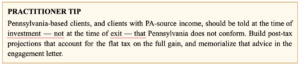
Federal QSBS benefits do not automatically translate into state tax savings, and this is the most common source of client disappointment. A handful of states decline to follow §1202 altogether. The list is no longer static: legislatures have moved in both directions since the OBBBA, and conformity should be confirmed as of the anticipated closing date rather than assumed from a prior engagement. As of this writing:
Because at least one of these measures applied retroactively within its enactment year, clients in high-rate conforming states should not treat present conformity as settled. A domicile change before a sale is sometimes warranted, but it must be bona fide, documented, and undertaken well in advance.
Coming next in this series: Part II — Does the Business Qualify? The gross asset ceiling, the continuous 80% active business requirement, and the excluded trades and businesses under §1202(e)(3).
For further information on this topic, please reach out to Filip M. Rams at frams@smgglaw.com
Disclaimer
This article is provided for general informational and educational purposes only. It does not constitute legal or tax advice, and does not create an attorney-client relationship. The law in this area is complex and fact-specific. Readers should consult qualified legal and tax counsel before taking any action based on the information contained herein. Prior results in similar matters do not guarantee a similar outcome.


©2026 Strassburger McKenna Gutnick & Gefsky | All Rights Reserved | Attorney Advertising | Disclaimer | Sitemap
